
Week 2: All about china
SUSTAINABILITY: BIG PICTURE
RESEARCH:
Introduction:
- Method Of Cooking: Balance of opposites (yin & yang); frying; boiling, steaming
- Learning Objectives:
-
Introduce the history of China, its geography, far-reaching philosophical, religious, and cultural influences, and its climate.
- China is known as one of the oldest continuing civilizations; the Silk Road was the birth of culture spreading across the globe as we know. The warmer year round climate in the South of China allows for the growth of rice, sugarcane, produce, and pond-raised fish
2. Discuss the importance of the Silk Road, how it connected China across continents to the Middle East, the Mediterranean, and Rome, and its effects on Chinese cuisine.
- The Silk Road became known as the trade of all global cultures. Ranging across China to Iran, Iraq, India & ending in Instanbul. Smaller chains spanned across Korea, Japan, the Indonesian Spice Islands, Turkey, Ethiopia & Rome.
3. Introduce China’s culinary culture, four main regional cuisines, and dining etiquette.
- The four main regional cuisines consist of:
Northern China, Beijing: Robust, Pungent & Delicate
Coastal/Eastern China, Shanghai: Refined, Subtle & Creative
Western China/Inland, Szechwan, Yunnan, Hunan: Spicy & Complex
Southern China, Canton, Guangzhou, Taiwan: Simple, Light & Innovative
4. Identify Chinese foods, flavor foundations, seasoning devices, and famous cooking techniques.
- Flavor profiles include: the five elemental tastes- fire, earth, metal, water & wood. Fire=bitter, earth=sweet, metal=spicy, water=salty, wood=sour.
Seasoning devices: seasoning veggies (scallions, ginger, garlic, onions)
fermented black beans, plum & oyster sauces, sesame pastes, preserved cassia blossoms, dried fruit peels, hot mustard..
5. Teach by technique and recipes the major dishes of China.
- Prior Knowledge:
My prior knowledge in regards to China before this week's lecture was only based in personal/relational experience. One of my best friends, Alena Jen, has taught me quite a bit about some signature Chinese dishes that she has grown up with her mom making.
Background Info:
Research: China is known for being the birthplace of global culture as we know it. But, the nation also has a long and rich history of its own, changing/flowing through history & the various dynasties. These dishes are just a few examples of this fact.
The first dish, Szechwan Sour & Hot soup originates from Sichuan, a land-locked province in the southwest part of the country (Google Maps). This area is notorious for being innovative with proteins, and packing dishes with chili peppers. The soup is claimed by both the Hunan & the Sichuan Provinces of China, but the soup actually originated in Northern areas, close to Beijing (Fine Cooking).
The second dish, Velveting Shrimp & Chicken in Oil (to pair with rice) has an interesting back story. The original process came from Southern China- created so people could use a whole animal & makes tougher cuts of meat lock in their flavor and enhances the potentially rough texture. According to Serious Eats & our textbook, the process of velveting the protein before stir-frying is crucial. Doing this process speeds up the cooking time, makes the meat more tender, keeps food from sticking to the wok, and food absorbs less oil from the pan (since already surrounded in layer of oil). The protein is to be marinated in egg whites & cornstarch, then dipped in hot oil before stir-frying. This allows the meat to have a smoother, "velvet"like texture.
https://guide.michelin.com/mo/en/article/dining-in/technique-thursday-velveting-in-chinese-cooking
Fermented Black Bean Sauce, contains fermented black soybeans, which is one of (if not the) oldest ingredient to be used in Chinese cuisine. The ingredient has record of being in marked containers in an ancient tomb in the Hunan Province back in 165 BC.
Method Of Cooking: China is so diverse, and because of this fact, there are many styles of cooking methods that can be used- multiple methods can be used in one meal. Some of the most common methods are: Stir-frying, deep frying with oil, steaming, braising, boiling & roasting.
Dish/Method Variations: The dishes we are preparing can be prepared in a variety of ways, depending on the Four Schools. These refer to the cooking habits of Shandong, Su, Cantonese, and Sichuan. Four additional types were developed in the following territories: Hunan, Fujian, Anhui, and Zhejiang
http://www.cits.net/china-travel-guide/four-major-cuisines-in-china.html
Recipes:
Plan Of Work:
Reflection:
Results/Lab Outcomes:
Our first lab was a huge success! It was so much fun working with our new equipment in the Rane Center for the first time! We definitely need to work on our time management, but we did well overall.
- Success Of Cooking Method:
The most successful cooking method was the balance of yin & yang and the five flavor profiles.
- Sensory Results:
- Taste:
~ Szechwan Soup: very powerful pops of red chili! the initial pop mellowed out, but led to a sour/bitter flavor from the vinegar. The prosciutto added a lovely layer of umami/saltiness.
~ Shrimp/Chicken: the taste was on par with hibachi restaurants, but a level up because of the love, care & homemade(ness) to the food!
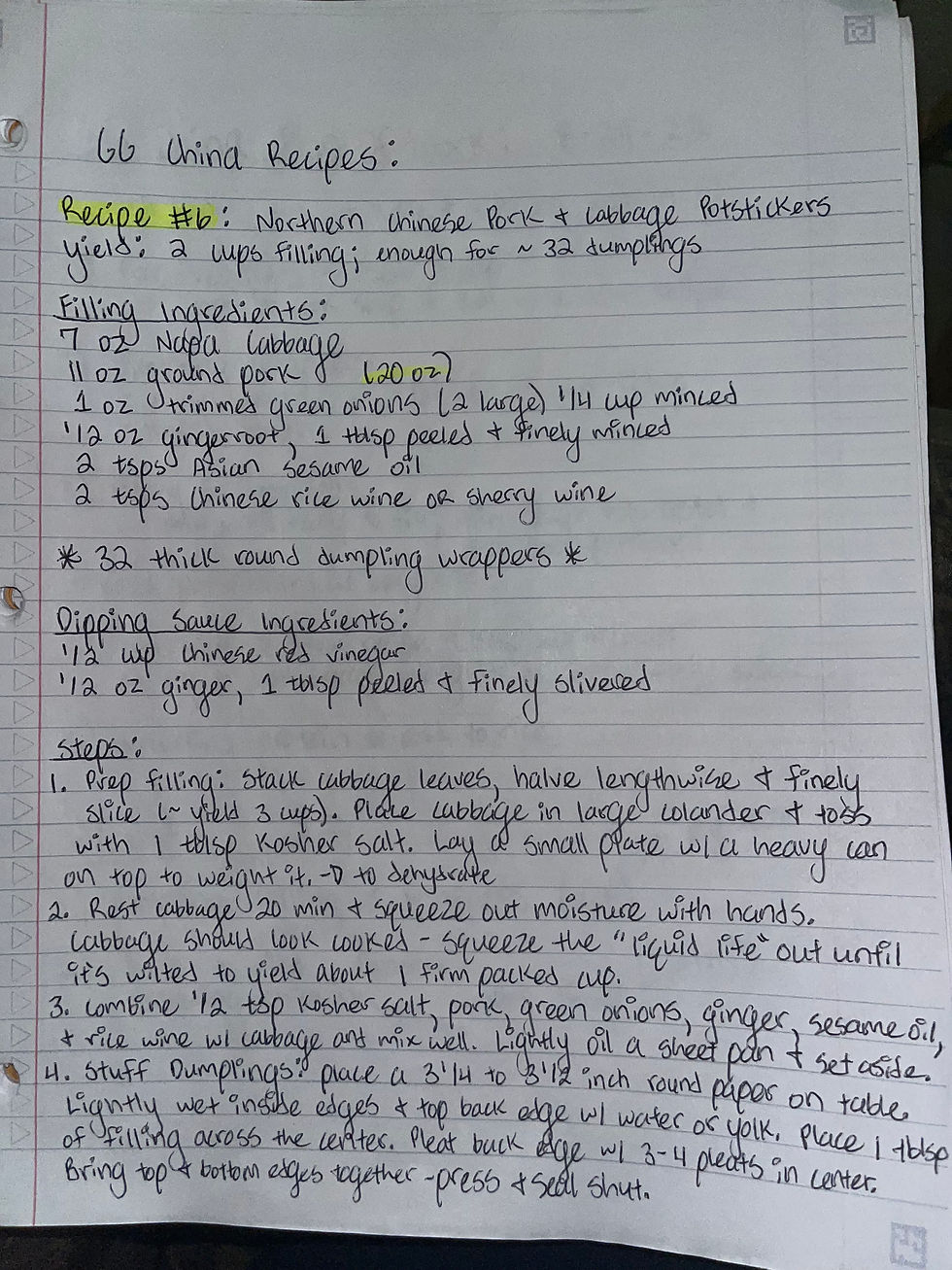
~ Pork & cabbage potstickers: these were great with the sauces we prepared- the inside could have used a little more salt/soy sauce.
- Flavor: the flavor of all the dishes balanced each other. We had salty/fried food, starch from the rice, sour/bitter from the soup. There could have been a little more sweet, but some sweetness came from the rice and the sauces for the potstickers/dumplings.
- Texture:
~ Just like the flavors, the textures were also pretty well balanced throughout our meal! The dumplings that were steamed had more of a chewy texture, whereas the fried dumplings had a nice crunch! The rice was firm, but still fluffy.
- Appearance:
~ The appearance of all our dishes were beautiful! We tried to use dishes that resembled Chinese traditional dishes. Obviously what we have is not what Chinese families would use.
Evaluation Of Results:
What worked well?
- My group mainly worked on the potstickers- these worked super well! The better way to make the dumplings was to have a hot pan with oil & char both sides of the dumpling.
What did not work well?
Steaming the dumplings did not work as well. The dumpling wrapper became very sticky after the steaming process, and the wrappers started to rip when we went to serve the food.
Improvements to be made:
To improve the steamed dumplings, maybe we could have the paper at the bottom of the basket be dampened slightly before placing the dumplings into the basket.
Conclusions:
In conclusion, this first lab was very successful!All of our guests seemed to thoroughly enjoy our plates, and it was great working in our new building.
Inspiration Photos:



Szechwan Hot & Sour Soup
Elaine. (2022, April 13). Hot and sour soup-suan La Tang. China Sichuan Food. Retrieved August 31, 2022, from https://www.chinasichuanfood.com/hot-and-sour-soup/

Velveted Chicken
Bill. (2022, June 27). How to velvet chicken for stir-fry: Chinese cooking 101. The Woks of Life. Retrieved August 31, 2022, from https://thewoksoflife.com/how-to-velvet-chicken-stir-fry/

Pork Dumplings/Potstickers
Pam. (2021, October 29). Pork potstickers. For the Love of Cooking. Retrieved August 31, 2022, from https://fortheloveofcooking.net/2019/03/pork-potstickers.html

Fermented Black Bean Sauce
Queen, R. by B. (n.d.). Chinese black bean sauce. Allrecipes. Retrieved August 31, 2022, from https://www.allrecipes.com/recipe/282584/chinese-black-bean-sauce/

Rice Cooked Via Rice Cooker
Leaird, K., & Spaeth, S. (2022, August 3). We tested 11 rice cookers-here are our favorites. Serious Eats. Retrieved August 31, 2022, from https://www.seriouseats.com/the-best-rice-cookers

