
Week 6: A fermented blog
INTRODUCTION:
Cookery Topic: Pickling, fermentation, & condiments
The Menu:
-
Ginger Beer
-
Sauerkraut
-
Sour Pickles
-
Yogurt
-
Creme Fraiche
MY PRIOR KNOWLEDGE:
My knowledge about fermented food and beverages is very limited; I learned so much today from our guest speaker! I did not realize there was more to fermented food than just sauerkraut and kimchi. I'm interested to look into the process of fermenting coffee beans and cocoa beans.
LEARNING OBJECTIVES:
-
Learning more about fermentation & the process of making fermented foods and beverages
Background:
Fermentation potentially started in ancient Egypt, when the more wealthy would make their own beer. It has been noted by Britannica that the Egyptians took beer making so seriously, that they named their creations, " heavenly" or " joy bringer" . There are hieroglyphics depicting Egyptians making alcohol, it was so important to them that mummies were often buried with bottles of wine or beer. There are many cultural ties to fermentation as well- fermentation can define a culture, like Italian wine and beer in NorthEastern Europe. Also, immigrants brought fermentation and pickling recipes
Encyclopædia Britannica, inc. (n.d.). Know why fruit flies are attracted to yeast and how they improve the flavour of Beer. Encyclopædia Britannica. Retrieved September 22, 2021, from https://www.britannica.com/video/186972/fruit-flies-flavour-beer.
Pickling: The process of pickling, "involves putting food into an acidic brine to produce a sour flavor. On the other hand, fermenting gives food a sour flavor without any added acid." Pickling is essentially a subsection of fermentation.
Spices Inc. . The difference between pickling and fermenting. (n.d.). Retrieved September 22, 2021, from https://www.spicesinc.com/p-8828-the-difference-between-pickling-and-fermenting.aspx#:~:text=An%20easy%20way%20to%20remember,terms%20of%20these%20two%20foods.
Methods Used:
This week, working with fermentation and pickling, it would have been great to paired the sauerkraut with Conecuh sausage dogs or hotdogs, and maybe made our own yellow mustard if possible. Also, if we could make ramen noodles to mix the kimchi into.
Recipes & Plan Of Work:

My Inspiration :
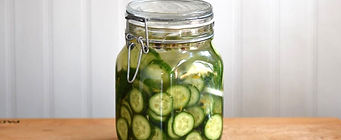
Bread & Butter Pickles
Emillie, A. (2021, June 28). Fermented honey garlic pickles. Fermenting for Foodies. Retrieved September 22, 2021, from https://www.fermentingforfoodies.com/honey-garlic-pickles/.

Our Ginger Beer will be packaged one day!
LGinger beer - powell & mahoney craft cocktail mixers. Powell & Mahoney. (2021, July 28). Retrieved September 22, 2021, from https://www.powellandmahoney.com/product/ginger-beer-case/.

Creme Fraiche
Illustrated, C. (n.d.). Sous vide crème fraiche: Cook's illustrated. Sous Vide Crème Fraiche | Cook's Illustrated. Retrieved September 22, 2021, from https://www.cooksillustrated.com/recipes/11551-sous-vide-creme-fraiche.
Making Pickles

Ginger Beer

Crème Fraîche
WEEK 6: REFLECTION
Lab Outcomes: For week 6 lab, we worked with Dr. Danderson on making fermented products, like Ginger Beer, Sauerkraut, Dill Pickles, Crème Fraîche, and Kimchi. All of our fermenting jars were left with loose lids, and placed in a hotel pan in the corner of the room to allow them to ferment in a cool environment. The pan is in case the jars leak.
Dish Results:
Ginger Beer: This week, Magen worked on making the ginger bug mixture, which will be used next week for ginger beer. The ginger bug mixture was made of peeled, as well as grated ginger. Both mixed with sugar and water- this mix will sit in the room temp lab with a loose lid until next week. Then, the process of making ginger beer will start.
Sauerkraut: AP worked with Dr. Danderson on the sauerkraut- it was super cool! After shredding the cabbage, they massaged it to release water from the vegetable, and then mixed in juniper berries. Lastly, the mixture was pressed down into mason jars.
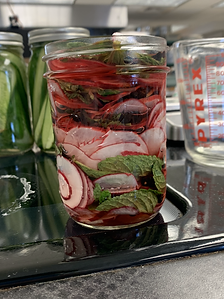
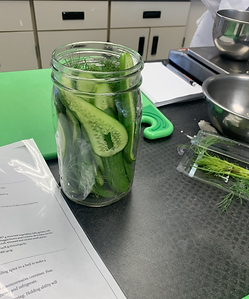
Dill Pickles: For the dill pickles, there were a variety of approaches that could have been used. Will & Sophia made a salty brine, and packed the jar with cucumber spears , dill, peppers from the TA's garden, garlic, and bay leaves. They also did the same process with radishes, mint, and juniper berries (awful smell, but good for fermenting).
Crème Fraîche: for our crème fraîche, we first used heavy cream instead of buttermilk (typically used). The cream was heated to 72 degrees F, and then the mesophillic culture was added to the saucepan of cream. The mix was stirred for 5 minutes, and then jarred with a loose lid. After 15-24 hours, the jar is to be refrigerated.
Kimchi: Alena & I cut the cabbage into thicker shreds than the sauerkraut. After cutting the cabbage, we mixed in spices like cumin, ground cayenne pepper, and garlic powder. We made a salt water brine, and poured this over the cabbage in the jar. We placed dried chilis in the bottom and top of the jar to add some flavor. Lastly, we used the outer leaves of the cabbage to press down the top of the jar.

.jpeg)