
WEEK 3: A yeast dough blog part 2
INTRODUCTION:
COOKERY TOPIC: Yeast Doughs Part 2- Sponge Method
COOKERY METHOD: Pre-Fermentation
THE MENU:
-
French Bread Sponge- use w/ app
-
Rustic Sourdough- serve with french onion soup
-
Pumpernickel Bread- serve with tapenade, as a cleanser
MY PRIOR KNOWLEDGE:
My prior knowledge about the french bread is limited to what we made last week- the french bread had a hard crust and a soft middle. I feel like using sponge method will make the crust not so crunchy. I know that sourdough bread is typically used in deli sandwiches, but that is the extent. I'm not too familiar with pumpernickel bread, but I imagine it being more like a whole wheat/grain bread.
LEARNING OBJECTIVES:
-
Explain the methods for preparing sponge doughs, and prepare sponge doughs and yeast pre-ferments.
-
Prepare and maintain sourdough starters, and use them to mix doughs.
-
Ferment and bake sponge dough and sourdough products.
BACKGROUND:
When utilizing the sponge method, there's a two step process: first the yeast has to be mixed with the liquid and half of the flour to create the sponge. The sponge is then set aside, and then move on to the second step. The second step includes mixing the rest of the ingredients into the sponge, and allowing that to rest.
The sponge method is specifically used for whole grain breads - it provides a lighter texture and gives more complex flavors.
Using the sponge method, there is a shorter fermentation period. Also, the crust and inside appear the same as typical sourdough
RECIPES:
My Inspiration:
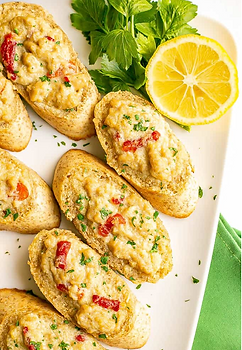
Use the French Bread for Crab Melts!
Doherty, K. (2021, September 20). Crab melts appetizer. Family Food on the Table. Retrieved January 27, 2022, from https://www.familyfoodonthetable.com/crab-melts-appetizer/

Sourdough bread bowls for french onion soup
Rees, L. (n.d.). French onion soup with sourdough and gruyere toasts by maisonrees: Quick & Easy Recipe. The Feedfeed. Retrieved January 27, 2022, from https://thefeedfeed.com/maisonrees/french-onion-soup-with-sourdough-and-gruyere-toasts

Pumpernickel Bread for Gravlax
Avocado toast
Hamilton, G. (2020, February 19). The Best Party trick: Make your own gravlax. The New York Times. Retrieved January 27, 2022, from https://www.nytimes.com/2020/02/18/magazine/salmon-gravlax-recipe.html


Week 3: Reflection
Lab Outcomes: This week we continued our study of yeast doughs by baking sourdough bread, pumpernickel, and french bread via the sponge method. For most of our groups, our sourdough bread did not turn out exactly as planned- potentially because the dough did not have enough time to ferment. My group's french bread came out perfect & our pumpernickel was too hard.
Dish Results:
French Bread (Sponge): my group's french bread came out absolutely perfect! There was a firm crunch on the outside, while the inside was super soft and had huge air bubbles! After combining the dough ingredients, the dough was mixed on speed 2 for 3 minutes. After these 3 minutes, the poolish mix was then slowly mixed in. We used 256.5g of the poolish. We allowed the dough to proof in a turned off oven until doubled in size. For baking a loaf, we set the oven on 425F for around 15 minutes.
Sourdough Bread: When making the sourdough bread, the class had started to run out of starter- I suppose one group has used too much. Therefore, my group had to combine 80g of bread flour, 80g of water, and the starter yeast that had only fermented for around 30 minutes- 1 hour. Our sourdough came out very hard, but had a golden color crust.
Pumpernickel Bread: this recipe could have been made with two different starters: with an onion, or without an onion. The onion seemed to be used as a source of acidity, but the taste of the two breads remained the same for me. The onion may have also provided another source of sugar for the yeast. Our bread came out huge! We realized that the issue with our dough was we accidentally used whole wheat flour and not clear flour.
Results Evaluation:
Overall, there were flaws in this lab, but many lessons were learned. First, we learned that timing is everything. Watching the clock while things are baking, and being able to rotate the products about halfway through the baking process is crucial for us to make sure we keep in practice. What did not work was when we made the pumpernickel bread and misread the recipe- potentially while we are getting ready for lab, we can highlight key words to ensure we keep this in check.
Conclusion: In conclusion, we all learned a lot from this lab. Be more cautious of time, communication with group members, and knowing that sometimes failure is ok as long as we learn something from it and avoid it in the future.
FOOD COSTS:

