
Week 3: A Charcuterie Blog
INTRODUCTION:
Cookery Topic: Charcuterie & Sausage
The Menu:
-
Irish Breakfast Sausages
-
Italian Sausage
-
Grandma Plana's Cuban Sausage
-
Finale Gravlax
MY PRIOR KNOWLEDGE:
My prior knowledge of sausage and the process of making it is very limited. I have enjoyed Conecuh sausage for the past few years- I love using this type in gumbo.
LEARNING OBJECTIVES:
-
Understand the role of sausages in culinary history
-
Identify necessary ingredients for sausages
-
Explain the importance of proper equipment selection, care and use in making sausages
-
Classify various types of sausage
-
Discuss fermented sausages and their manufacture
-
Describe the process of making basic grind sausages
-
Contrast the basic process with the procedure for emulsion sausages
-
Recognize the value of testing
-
Distinguish suitable garnishes for sausages
-
Clarify the various types of sausage shaping options and preparation methods for each type
Background:
The Science In Sausage-
There is much science that goes into processing sausage into an edible form that I never realized before! According to Newly Weds Foods, there are many factors that must be considered when crafting sausage links. First, the amount of fat in the meat being used is crucial. Depending on the type of meat, the fat amount can range from around 24-42%. The fat aids in flavor, as well as keeping the meat inside the casing bound together.
The History of The Sausage:
The history of sausage making has some wide roots; some of the research I have done states that sausage was being made around 4,000 years ago by the ancient Sumerians. Other sources state that sausages were created by the Greeks in the 8th or 9th century B.C.E. Their purpose was to preserve the blood, offal, and small scraps of meat in an edible container from the same animal (Sausage House). Later in history, Egyptian murals were found where sacrificial cattle were, after death, used to make sausage (Atlas Obscura).
Newly Weds Foods. (2018, February 12). The science of sausage. Newly Weds Foods. https://newlywedsfoods.com/the-science-of-sausage/.
McRobbie, L. R. (2017, November 14). The mysterious origins of a food that's always BEEN funny: The sausage. Atlas Obscura. https://www.atlasobscura.com/articles/the-mysterious-origins-of-a-food-thats-always-been-funny-the-sausage.
Methods Used:
When making sausage, it seems like a general rule to use between 24-42% fat; the more fat used, the better the flavor of the meat. And when making sausage in casings, the better the shape will be. The most simple type to make is breakfast or Italian sausage, which can be made from any kind of meat, but pork is most commonly used. A second important rule of thumb is to always have the equipment be as cold as possible. When making sausage, it is super important to remove the silver-skin, tendons, & ligaments of the meat. Also, the meat must be diced a little smaller the the feeding hole on the grinder.
Basics Of Making Sausage. Backcountry Chronicles. (n.d.). https://www.backcountrychronicles.com/basics-of-making-sausage/.
Recipes & Plan Of Work:
My Inspiration :

Bangers & Mash!
Kitchens, E. (2021, March 14). Basic Irish Sausages. Epicurus.com Recipes. https://www.epicurus.com/food/recipes/basic-irish-sausages/7122/.
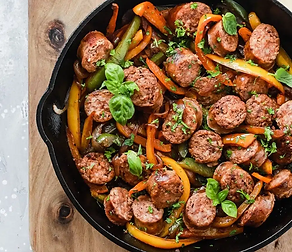
Italian Sausage One Pot

Gordon, J. (n.d.). Beet cured Salmon Gravlax. / Recipes // Jackie Gordon Singing Chef. https://www.jackiegordon.com/index.php/recipes/beet_cured_salmon_gravlax.


WEEK 3: REFLECTION
Lab Outcomes:
For week 3 lab, we finished the gravlax, sliced the fish, and plated the fish with bread & homemade cream cheese. We practiced making sausage fillings with Dr. Traynor, as well as opening sheep casings, and filling the casings.
Dish Results:
Irish Sausage: the Irish sausage filling consisted of pork shoulder, yellow onion, dried sage leaves, Panko bread crumbs, plus salt & white pepper. The texture of the filling was very soft, and once in the casing, there was a firmer texture.
Grandma Plana's Cuban Sausage: this dish is a Spanish-style olive sausage. The texture was very soft, almost like a meatloaf type of food. The taste was great- I really enjoyed the umami flavor profile. The sausage had a mellow pink color, and resembled something like spam.


Results Evaluation:
We first had to wet the sheep casings, so they would have a wide enough opening to fit on the sausage stuffer machine. I did not expect for the sheep casings to have different sizes, as well as being that tight. The process of filling the sausages went well, but along with opening the casings, the process was a little time consuming. Potentially, the casings could be pre-soaked the day before, or the meat could be ground the day before as well.
The Cuban Sausage process was super interesting!