WEEK 4: A yeast dough blog part 3
INTRODUCTION:
COOKERY TOPIC: Rich yeast dough
THE MENU:
-
Sweet Bread Rolls (2)
-
Croissants (1)
-
Brioche Cups (3)
MY PRIOR KNOWLEDGE:
My prior knowledge of sweet bread rolls is a little more extensive; I do know that I have seen them when passing a bake shop window. This dough is used to make different shapes, like cinnamon rolls and small fruit tarts. I really enjoy croissants as well as chocolate covered croissants, so it will be really cool making them ourselves without a layering machine. This process will allow me to better appreciate the product. Lastly, I learned in lecture that brioche dough is not only used for rolls or cups, but is also used for making beignets, which are my absolute favorite!
LEARNING OBJECTIVES:
-
Produce simple sweet doughs.
-
sweet rolls/filled tarts
-
-
Produce laminated yeast doughs.
-
croissants & danishes- both have layering techniques
-
-
Make up a variety of products using sweet doughs, laminated doughs, and sweet-dough fillings and toppings.
BACKGROUND:
Since I am a huge fan of croissants and their multiple uses for breakfast, desserts (chocolate croissants), as well as newly used for sandwich bread, I decided to dive deeper into their origins, as well as creating a better understanding of the folding technique. According to The Smithsonian Magazine, the croissant was originally inspired by the Austrian kipfel, or a cookie in the shape of a crescent moon. The cookie contained, "a generous amount of butter or lard and sometimes sugar and almonds" (Smithsonian). The cookie seems to have become a thing after the Siege of Vienna when the Austrians beat the Ottomans. Understanding this history note better allows me to appreciate the delicacy. The technique has been around for ages, and the time put into the process is worth it.
The actual creation of a croissant is a real technique. The preferred butter used must be COLD European butter. The butter is to be cut into half the size of the dough, and then the other half of the dough is placed on top of the butter. Once we start folding the dough, the first fold is over on themselves. This will create 9 folds. A second fold the same way increases the amount to 25 folds, which seems to be standard (The Flavor Blender)
Magazine, S. (2015, April 30). Is the croissant really French? Smithsonian.com. Retrieved February 2, 2022, from https://www.smithsonianmag.com/arts-culture/croissant-really-french-180955130/
K, D. (2020, July 10). Homemade French croissants (step by step recipe). The Flavor Bender. Retrieved February 2, 2022, from https://www.theflavorbender.com/homemade-french-croissants-step-by-step-recipe/
RECIPES:

My Inspiration:


ALMOND CROISSANTS
Saffitz, C. (2021, April 7). Almond croissants. The New York Times. Retrieved February 3, 2022, from https://cooking.nytimes.com/recipes/1022062-almond-croissants

Sweet Bread Cinnamon rolls
Amira, A. (2020, June 25). Sweet Bread Roll Recipe (shoreek). Amira's Pantry. Retrieved February 3, 2022, from https://amiraspantry.com/bread-roll-recipe/


Week 4: Reflection
Lab Outcomes: This week was our final week of practicing yeast doughs. Because of all that we wanted to create this week, but our time goes by so fast, we decided to make the croissant dough and freeze it, so next week we'll have a jump start. The brioche dough and sweet dough offered a variety of shapes we could use.
Dish Results:
Croissants: we started off by making the croissant dough, and allowing it to rest/ferment for 1.5 hours. After this resting period, we rolled out the dough into a rectangle shape and placed the frozen butter pats on the dough, and folded it back onto itself to make a closed pouch. My group made some observations while preparing the dough: when mixing, it is best to use the hook attachment to reach all the way to the bottom of the bowl. Also, our dough was VERY thick after mixing. We decided to add at max 2g of water, in order to give the dough some movement. We had to avoid kneading the dough too much, so the gluten would not start developing until next week.
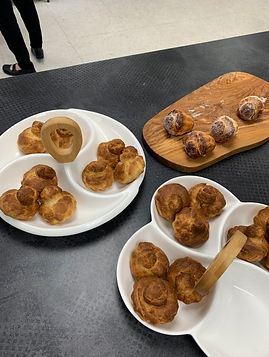
Sweet Bread Rolls: the sweet bread rolls used the modified straight dough method, which meant we threw all the ingredients in and did the intensive mix- 5 to 6 minutes on low speed, and then 3-4 minutes on a faster speed. The proofing process was conducted on top of the stove to speed up the bread rising. We then baked the rolls for around 10 minutes at 375F. We practiced rolling the sweet bread rolls, which was an interesting learning curve for me- I need to continue my form technique, but I believe I was getting the hang of it.
Brioche Cups: this dough recipe created the most diverse products from my class. One group made churro type products, which were so good! My group was not exactly sure what shape to do, but we practiced the "cross" shape, and it was a work in progress!
Results evaluation: This lab was definitely a learning curve. We all were becoming impatient with the dough and with the proofing process. We learned that our time management skills are always developing.
Conclusion:
Of the objectives from this week, I feel like I best understood the sweet rolls and fillings for a tart. We only were able to slightly work with croissants, and I understood the folding over the cold butter technique, but I am excited for next week when we learn the layers technique and how to do so by hand. Learning this technique will allow us to better appreciate the machinery we can use later to fulfill this task.
IMAGES:
Sweet Bread with Apple Cinnamon Filling Cinnamon & Regular Brioche Cups